Games like Dark Souls are easy to describe badly. Difficulty alone is not enough. The strongest alternatives recreate some combination of deliberate combat, checkpoint pressure, recoverable resources, dangerous exploration, shortcut-heavy worlds, difficult bosses, build experimentation, and environmental storytelling.
That is why current 2026 recommendation lists include both close mechanical descendants and looser games that capture only part of the feeling. Our list focuses on what a Dark Souls player is most likely to miss after leaving Lordran.
Best Dark Souls alternatives at a glance
- Lies of P — polished modern Soulslike with precise defensive timing and authored progression.
- Lords of the Fallen — dark-fantasy action RPG with two overlapping worlds and strong modern co-op.
- Nioh 3 — faster, deeper combat and loot for players who want more systems.
- Salt and Sanctuary — one of the clearest 2D translations of the Souls formula.
- Mortal Shell II — compact dark-fantasy world with Shell possession and stamina-free combat.
- Elden Ring — FromSoftware's open-world expansion of the same design lineage.
- Bloodborne — aggressive FromSoftware branch with gothic-horror identity.
Lies of P: the focused modern choice
Lies of P is one of the clearest non-FromSoftware recommendations because its official site openly calls it a Soulslike. It combines difficult bosses, checkpoint progression, character stats, weapon upgrades, recoverable progression, defensive timing, and a dark authored world.
The weapon assembly system gives it a strong identity instead of simply copying Dark Souls weapon categories. Legion Arms also expand the toolkit without turning the game into a broad open-world sandbox.
Choose it if you want modern presentation and a relatively focused route. See our Lies of P profile for platform and multiplayer details.
Lords of the Fallen: dark fantasy and co-op
Lords of the Fallen is a strong match for players who want medieval dark fantasy, dangerous exploration, large bosses, numerous weapons, magic, and online systems. Its distinctive idea is the relationship between the living world and the Umbral realm, which changes routes and creates a second layer of exploration.
The game has also evolved significantly after launch. Its current shared-progression co-op and Friend's Pass make it more attractive than Dark Souls itself for two players who want to stay together for long sessions.
That difference is important: similar atmosphere does not require identical multiplayer design. Compare it in co-op Soulslike games.
Nioh 3: for players who want more mechanical depth
Nioh 3 keeps Souls-style danger and boss learning while adding far more active combat systems, loot, and optimization. Team NINJA's 2026 release uses Samurai and Ninja styles that can be switched instantly, plus open-field exploration.
It is less like Dark Souls in pacing and more like it in the relationship between danger, checkpoints, character development, and learning. If you found Dark Souls' combat too restrained, Nioh 3 is one of the strongest directions to move.
Salt and Sanctuary: Dark Souls translated into 2D
Ska Studios describes Salt and Sanctuary as fast, brutal, complex 2D combat combined with deep RPG mechanics, more than 600 weapons and items, shortcuts, traps, and a cursed world.
It is a particularly useful alternative because it shows which Souls systems survive when the camera and movement model change. Bonfire-like safe points, difficult encounters, builds, exploration, and shortcuts remain meaningful even in side view.
For more games in this direction, use 2D Soulslike games.
Mortal Shell II: familiar mood, different assumptions
Mortal Shell II retains a bleak dark-fantasy identity while using possession of different Shells as a major progression idea. Playstack describes a compact interconnected open world with more than sixty dungeons and combat unrestricted by stamina.
The lack of a traditional stamina limit makes it less mechanically conservative than some Soulslikes. That can be appealing if you want the atmosphere and high-stakes encounter design without reproducing every rule from Dark Souls.
Elden Ring: the obvious FromSoftware evolution
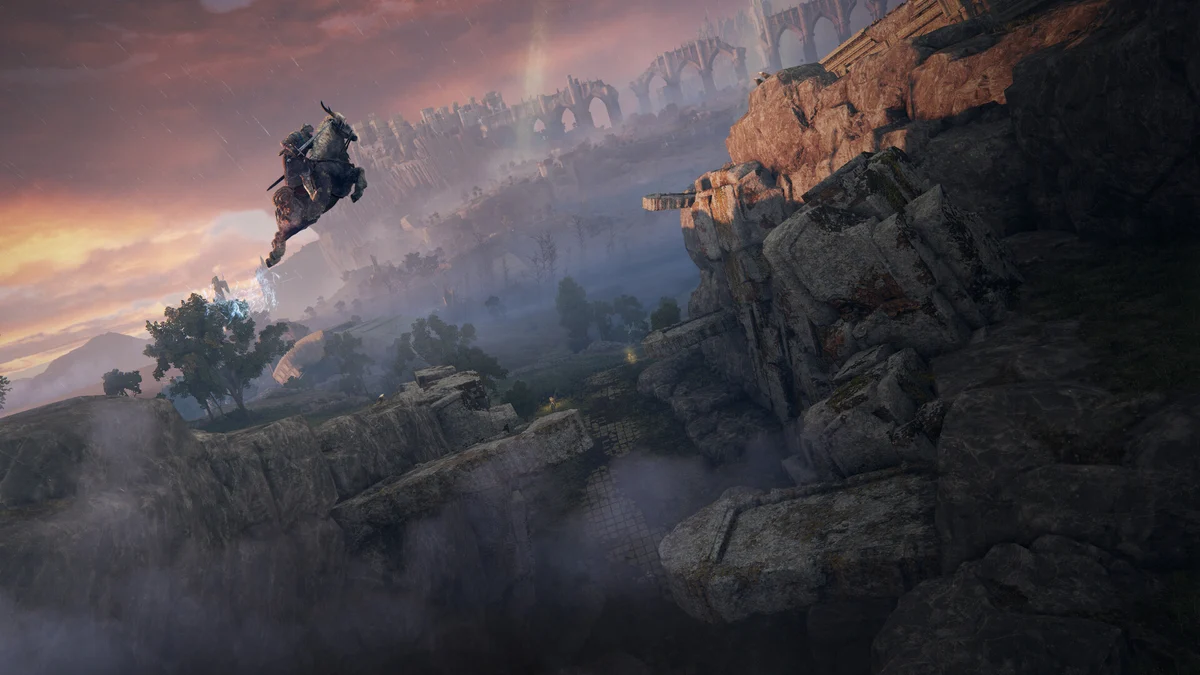
Elden Ring is simultaneously less like Dark Souls and more like it than almost any other recommendation. The combat language, build logic, bosses, environmental storytelling, and FromSoftware DNA are direct, but the open world dramatically changes how progression walls work.
If the dense interconnected structure of Lordran is what you loved most, Elden Ring may feel more diffuse. If builds, combat, bosses, and mysterious exploration were the main attraction, it is the natural next step.
See Elden Ring and games like Elden Ring for that branch.
Bloodborne: same lineage, more aggression
Bloodborne removes the expectation that Souls combat should revolve around shielded caution. Rally healing, firearms, Trick Weapons, quick movement, and gothic horror create a more aggressive version of the same learning-driven structure.
It remains officially a PS4 game that is playable on PS5 through backward compatibility. Platform limits therefore matter more here than for multiplatform alternatives. Read Bloodborne for the current status.
What makes an alternative genuinely useful?
A good Dark Souls recommendation should explain which part matches. One game may copy checkpoints but not world structure. Another may reproduce deliberate combat but use a linear campaign. A third may share the dark atmosphere while playing like a completely different action game.
For this site, similarity is therefore feature-based rather than cosmetic. If you want interconnected exploration, prioritize Lords of the Fallen, Salt and Sanctuary, or Mortal Shell II. If you want precise modern combat, prioritize Lies of P. If you want deep systems, choose Nioh 3. If you want FromSoftware's own evolution, choose Elden Ring or Bloodborne.
For the broader category rather than strict Dark Souls similarity, use best Soulslike games and what is a Soulslike.