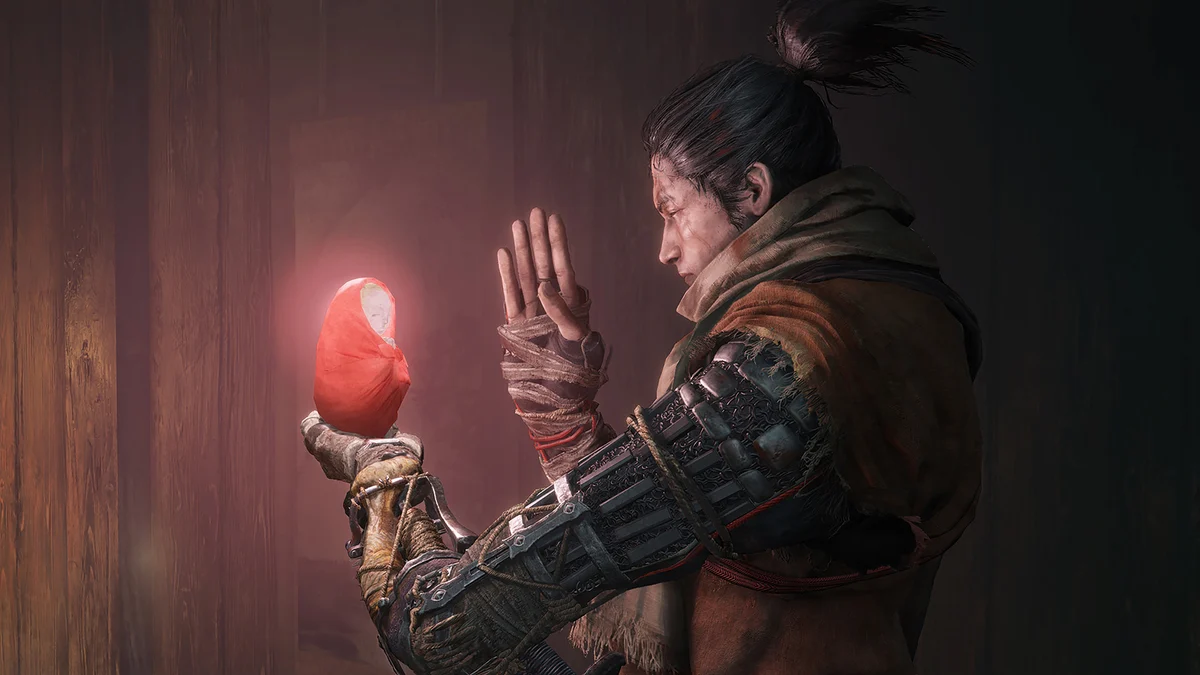
Sekiro: Shadows Die Twice is FromSoftware's single-player action-adventure built around sword mastery, posture pressure, stealth, vertical traversal, and a fixed protagonist rather than the broad character-build systems associated with Dark Souls or Elden Ring. PlayStation lists the original version for PS4 and notes that it is playable on PS5 through backward compatibility; the game is also available on Xbox and PC.
Sekiro is frequently grouped with Soulslikes because it uses checkpoints, repeated learning, demanding bosses, death pressure, and FromSoftware's encounter design. Yet it deliberately removes many systems that players assume are essential to the genre, making it one of the most useful boundary cases.
Quick facts
- Developer: FromSoftware
- Publisher: Activision outside parts of Asia; regional publishing varies
- Release: March 2019
- Core mode: Single-player
- Key mechanics: Deflection, posture, sword combat, prosthetic tools, stealth, grappling hook, resurrection
- Build structure: Much narrower than Dark Souls or Elden Ring
Deflection changes the entire combat loop
The center of Sekiro combat is not dodge rolling around every attack. Deflecting at the correct moment damages an enemy's posture and lets the player stay close, maintain pressure, and eventually create a deathblow opportunity.
This creates a combat rhythm where defense and offense blur together. A successful deflection is not merely damage prevention; it advances the fight. Boss mastery therefore feels unusually direct because the player gradually learns a sequence of timings until a duel that once felt overwhelming becomes controlled.
Posture matters as much as health
Many enemies can be defeated by breaking posture even when their health is not empty. Lowering health often makes posture easier to break, so the two systems interact rather than replacing each other.
This is why Sekiro can feel difficult to players who arrive with habits from Dark Souls. Constant retreat gives enemies room to recover posture. The game often rewards disciplined aggression, confidence, and staying engaged with the enemy's rhythm.
Prosthetic tools add tactical answers
The Shinobi Prosthetic gives Sekiro a range of tools that can exploit specific enemy weaknesses, control space, create openings, or extend movement. These tools provide tactical variety without turning the game into a loot-heavy RPG.
Because the protagonist's core identity is fixed, progression is more about learning the sword system, acquiring skills, upgrading prosthetic functions, and understanding encounters than assembling a completely different archetype.
Stealth and vertical traversal
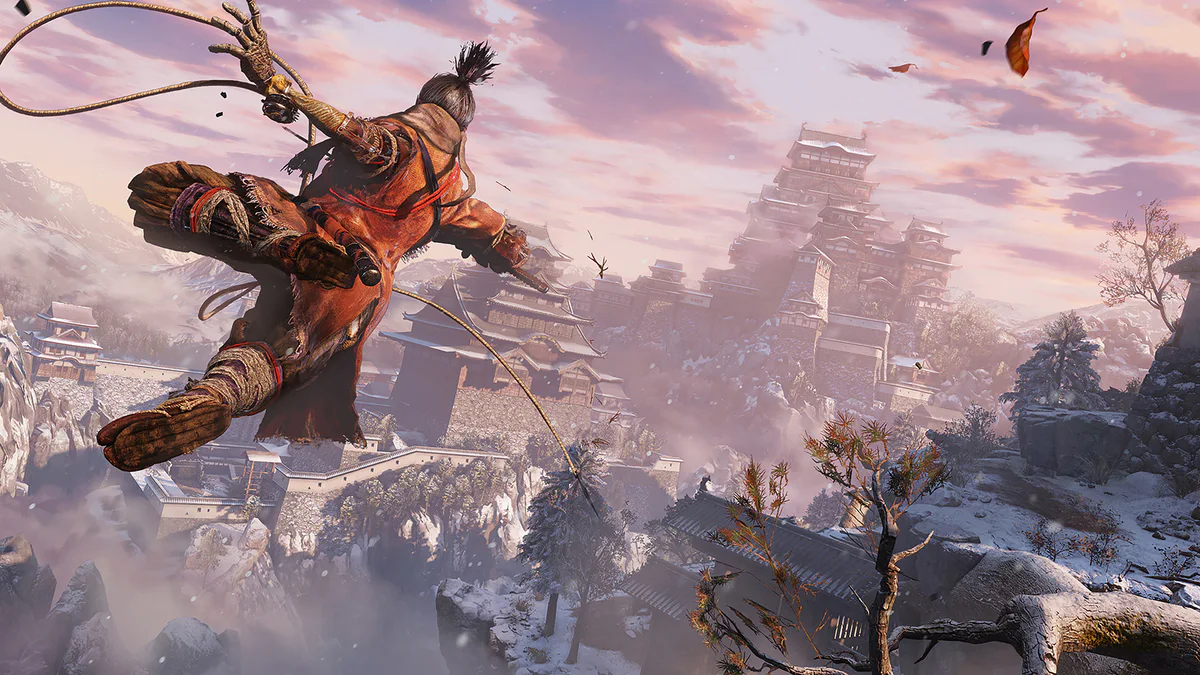
PlayStation highlights stealth and grappling-hook traversal as major parts of exploration. Sekiro can approach groups from above, reposition quickly, remove weaker enemies before a fight, and use vertical routes that would not fit the slower movement of early Dark Souls.
That movement also changes level design. Rooftops, cliffs, branches, and vertical shortcuts expand how players read spaces. Combat arenas often include opportunities to disengage or reposition in ways that are impossible in more grounded Souls games.
Resurrection changes the meaning of failure
Sekiro's resurrection mechanic can let the player return during an encounter after taking a fatal blow, but it does not turn death into a consequence-free retry. The mechanic becomes another tactical resource: do you revive immediately, retreat, finish a weakened enemy, or preserve an opportunity for a more important moment?
This reinforces the game's focus on momentum. The player is encouraged to stay engaged and recover from mistakes rather than treating every death as an immediate reset.
Is Sekiro really a Soulslike?
It depends on whether the term describes a strict RPG template or a broader design lineage. Sekiro lacks character classes, weapon loot, conventional stamina management, and co-op. It nevertheless shares checkpoint-driven progression, punishing enemies, repeated boss learning, meaningful death systems, interconnected exploration, and FromSoftware's information-through-failure philosophy.
Soulslike Wiki therefore treats Sekiro as part of the wider Soulslike conversation while clearly exposing the differences. That is more useful than arguing that every genre member must use the same stat sheet.
No multiplayer
Sekiro is a one-player game. Players who specifically want summons, invasions, arenas, or shared progression should use multiplayer Soulslike games instead.
The lack of online help also affects difficulty. When a boss blocks progress, the answer is usually to improve execution, change tactics, use a prosthetic tool more effectively, or find limited progression elsewhere rather than summon another human.
Is Sekiro a good first Souls game?
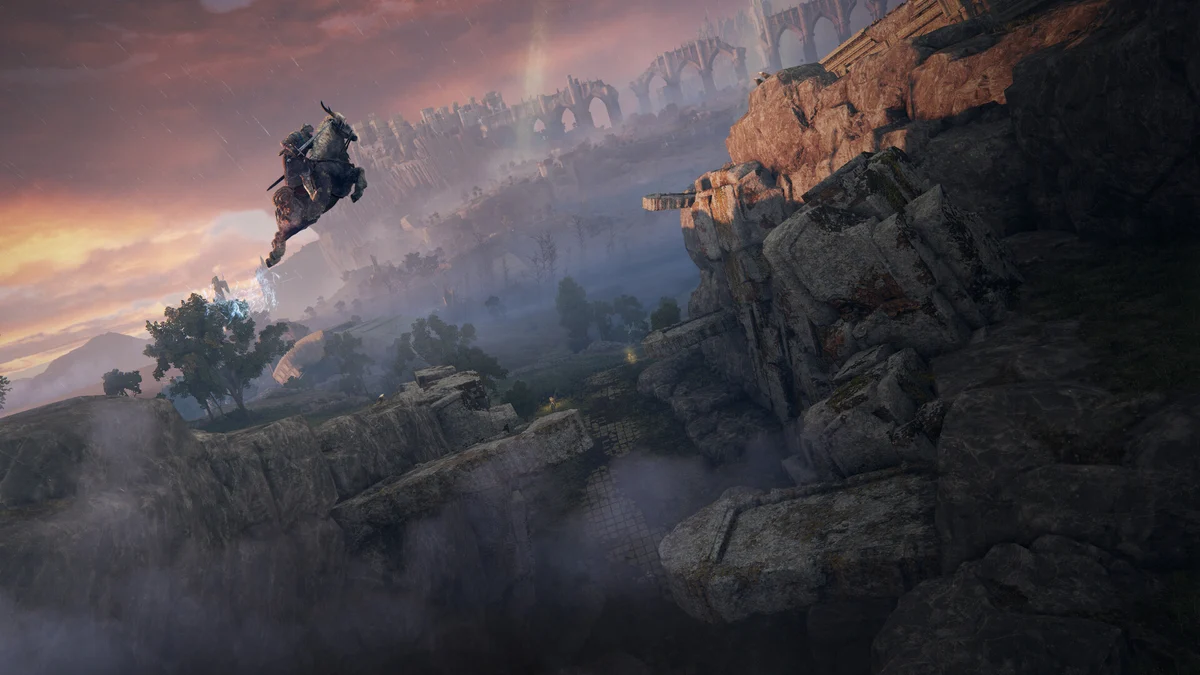
Only for the right player. If you already love parry systems, character-action games, or timing-driven duels, Sekiro's focused design can be easier to understand because there is less uncertainty about builds. If you want multiple ways to overpower or route around a problem, Elden Ring is more flexible.
See Soulslike games for beginners for the decision framework.
What should you play after Sekiro?
Look for games where defensive timing is central rather than merely available. Lies of P is a strong modern choice because guarding and precise defense matter heavily, while Nine Sols translates deflection-focused combat into a 2D structure.
Our games like Sekiro page focuses specifically on that search intent instead of listing every difficult action RPG.
Who should play Sekiro?
Choose Sekiro if you want one of FromSoftware's most focused combat systems, a fixed shinobi protagonist, demanding one-on-one duels, stealth, vertical movement, and a progression curve driven heavily by player mastery.
The important expectation is that improvement comes less from changing your build and more from changing your understanding. That makes success unusually legible: when a difficult duel finally becomes manageable, you can often identify exactly which timings, reactions, and decisions improved.
For the wider genre, compare best Soulslike games.